
Crude Fell and Your Petrol Price Didn't. Where the Relief Goes
Prices go up in a lift and come down by the stairs. In June we said the excise would be restored before the saving reached your pump. In July, rates were revised.
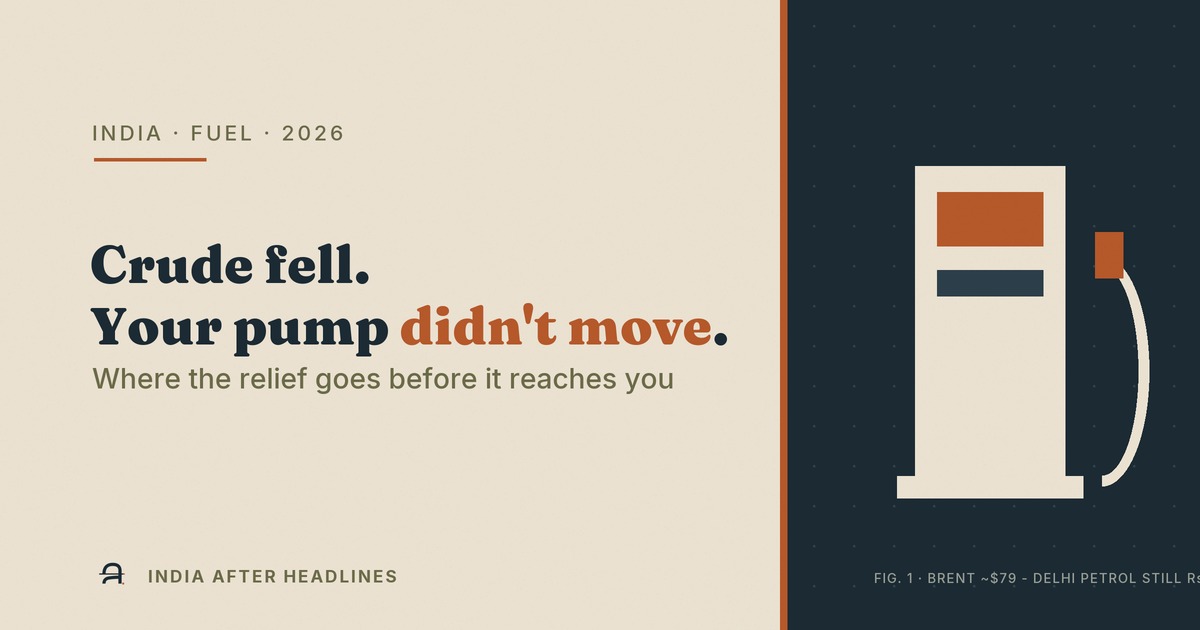
Short answer: Because the relief is intercepted before it reaches your tank. Brent settled at USD 78.96 on 16 June 2026 — the first sub-$80 close since March, about 20% off the 2026 peak — and Indian pump prices did not move: Delhi petrol around Rs 102, diesel around Rs 95. The reason is a mechanism worth naming: lag-and-intercept. On the way up, the government cut excise by roughly Rs 10 a litre (petrol Rs 13 to Rs 3, diesel near zero) and absorbed the shock, forgoing an estimated Rs 1.5-1.75 lakh crore a year, while oil marketing companies took losses of about Rs 11 a litre on petrol and Rs 14 on diesel. On the way down, restoring that duty and recovering those losses comes first. In July it did: excise component rates were revised with effect from 16 July 2026. Prices at the pump still have not fallen.
The principle nobody teaches you
Prices go up in a lift. They come down by the stairs — if they come down at all.
This is not cynicism, it is a description of a mechanism, and the mechanism has parts you can name and watch.
What happened, in order
January 2026: India’s crude basket around USD 63 a barrel.
18 March 2026: the Iran conflict pushes it to roughly USD 146. Had nothing been done, pump prices would have gone vertical.
March 2026: the government cuts central excise by about Rs 10 a litre — petrol from Rs 13 to Rs 3, diesel to near zero. This deserves to be said plainly: it worked, and it was the right call. The shock that should have hit your pump was taken onto the exchequer instead.
The cost of that protection: an estimated Rs 1.5-1.75 lakh crore of forgone annual revenue (analyst range), while at crude above USD 100 the OMCs were absorbing roughly Rs 11 a litre on petrol and Rs 14 on diesel (ICRA).
16 June 2026: Brent closes at USD 78.96, down nearly 5% in a day, as a ceasefire holds and the Strait of Hormuz moves toward reopening.
15-16 June 2026: Indian pump prices — unchanged.
So the relief reached the world. It did not reach your house.
What we said would happen next
When we covered this in June, the prediction was straightforward and not especially brave: with crude falling, the simplest path is to put the Rs 10 of excise back — refill the treasury, cover the companies’ losses — and the pump price stays exactly where it is.
What actually happened: central excise duty component rates on petroleum products were revised with effect from 16 July 2026, through Notifications 38/2026-Central Excise and 39/2026-Central Excise, replacing the earlier notified rates.
We are not going to claim more precision than the public record supports — the notifications restructure component rates, and reconstructing the exact net change per litre requires the notification text rather than a news summary. But the observable outcome needs no interpretation at all:
Brent is trading around USD 79. Petrol in Delhi is around Rs 102. Diesel around Rs 95. They have not moved since the OMCs’ revision of 25 May 2026, when petrol went up Rs 2.61 and diesel Rs 2.71.
Crude down roughly 20% from the peak. Pump price: unchanged.
Lag-and-intercept, defined
Give it a name and you will see it every time.
- Lag — when global prices rise, relief arrives late, and often as an excise cut rather than a price cut.
- Intercept — when global prices fall, the saving is absorbed as restored duty or recovered company margin before it reaches the retail price.
Both halves can be entirely defensible in isolation. The cut genuinely protected households in March. The companies’ losses were genuinely real. And yet the household never experiences the downside of the cycle, only the upside — which over a full cycle is not a neutral outcome.
The villain here is not a party, a government or a company. It is a mechanism that is asymmetric by construction, plus the fact that India imports about 85% of its crude, so the input price is never ours to set.
This is not a petrol story
Fuel is an input to almost everything you buy.
May 2026 wholesale inflation (WPI) hit 9.68%, and its single biggest engine was fuel and power, up more than 30%. That rides into vegetables, freight, and the price of anything that had to be moved by road.
The genuinely good news sits one level up: CPI was 3.93% in May 2026, below the RBI’s 4% target, and the RBI held the repo rate at 5.25% citing West Asian energy prices. Sustained cheap crude keeps retail inflation contained and reopens room on your EMI.
So relief is real. It is simply arriving in the macro numbers rather than at the pump, and those are two different addresses.
What to actually watch
One — does the ceasefire hold? It is fragile. If it breaks, crude climbs and this entire question resets.
Two — the next duty notification, not the next headline. Retail prices are set by the OMCs, but the space they have to cut is set by what the exchequer takes first. The document that decides your next fuel bill is a CBIC notification, and it will never be the lead story.
The choice between recovering revenue and passing on relief is a legitimate one, and there are honest arguments on both sides of it. The only thing worth insisting on is that it is a choice — not weather, not gravity, and not something that happens to India from outside.
You can now see where in the chain your relief stops. That is the part that used to be invisible.
Sources
- Brent crude settled at USD 78.96 a barrel on 16 June 2026, its first close below USD 80 since March and roughly 20% below the 2026 peak, following the winding down of the 2026 Iran conflict and moves to reopen the Strait of Hormuz. India's crude basket had risen from approximately USD 63 a barrel in January 2026 to approximately USD 146 on 18 March 2026
- Government of India — central excise duty on petrol and diesel reduced by approximately Rs 10 per litre in March 2026, taking duty on petrol from Rs 13 to Rs 3 per litre and duty on diesel to near zero, to shield consumers from elevated international crude prices; analyst estimates put the revenue forgone at approximately Rs 1.5 lakh crore to Rs 1.75 lakh crore a year
- Central Board of Indirect Taxes and Customs — Notifications 38/2026-Central Excise and 39/2026-Central Excise revised central excise duty component rates on petroleum products with effect from 16 July 2026, replacing earlier notified rates
- ICRA — at crude above USD 100 a barrel, oil marketing companies were estimated to be absorbing losses of approximately Rs 11 per litre on petrol and Rs 14 per litre on diesel
- Retail fuel prices — petrol and diesel prices in Delhi were unchanged through 15-16 June 2026 at approximately Rs 102 and Rs 95 a litre respectively, and remained steady into August 2026 following a revision on 25 May 2026 in which oil marketing companies raised petrol by Rs 2.61 and diesel by Rs 2.71 a litre. Brent traded around USD 79 a barrel in early August 2026
- India imports approximately 85% of its crude oil requirement
- Consumer Price Index inflation was 3.93% in May 2026, below the Reserve Bank of India's 4% target, while Wholesale Price Index inflation reached 9.68% with fuel and power up more than 30%; the RBI held the repo rate at 5.25%
Why is petrol not getting cheaper in India when crude oil falls?
Because the saving is usually absorbed before it reaches the pump. When crude spiked in early 2026 the government cut excise duty by around Rs 10 a litre to shield consumers, forgoing an estimated Rs 1.5-1.75 lakh crore a year, while oil marketing companies absorbed losses of roughly Rs 11 a litre on petrol and Rs 14 on diesel at crude above USD 100. When crude falls, restoring that duty and recovering those losses takes priority over a retail price cut. The pattern is lag on the way up and intercept on the way down.
Did the government restore the excise duty cut?
Central excise duty component rates on petroleum products were revised with effect from 16 July 2026 through Notifications 38/2026-Central Excise and 39/2026-Central Excise, replacing the earlier notified rates. The observable outcome at the pump is that retail prices did not fall: petrol in Delhi has held around Rs 102 and diesel around Rs 95 since the oil marketing companies' revision of 25 May 2026, even with Brent trading near USD 79.
When will petrol prices come down in India?
There is no scheduled date, because retail prices are set by oil marketing companies rather than announced on a calendar. A sustained fall in crude is a necessary condition but not a sufficient one. Two things decide it: whether crude stays low for long enough for the companies to recover accumulated under-recoveries, and whether the government treats the room created as revenue to recover or as relief to pass on.
How much of the petrol price is tax?
A large share, split between central excise duty and state VAT, which is why the same litre costs materially different amounts in different states. Central excise was cut by roughly Rs 10 a litre in March 2026 and component rates were revised again from 16 July 2026. Because the tax component is fixed in rupees per litre rather than as a percentage, it does not fall automatically when crude falls.
Does India's import dependence affect petrol prices?
Substantially. India imports approximately 85% of its crude oil requirement, so global price shocks pass into the domestic system in both directions and neither the government nor the oil companies control the input price. What is controlled domestically is how much of a global fall is passed through to consumers and how much is retained as tax or used to recover company losses.
Will Lab-Grown Gold Crash the Gold Price? No. Here's What to Check This Dhanteras Instead
Diamonds can be grown in a lab. Gold can't. The real fake-gold risk this Dhanteras is at the jewellery counter, and it takes two minutes to check.
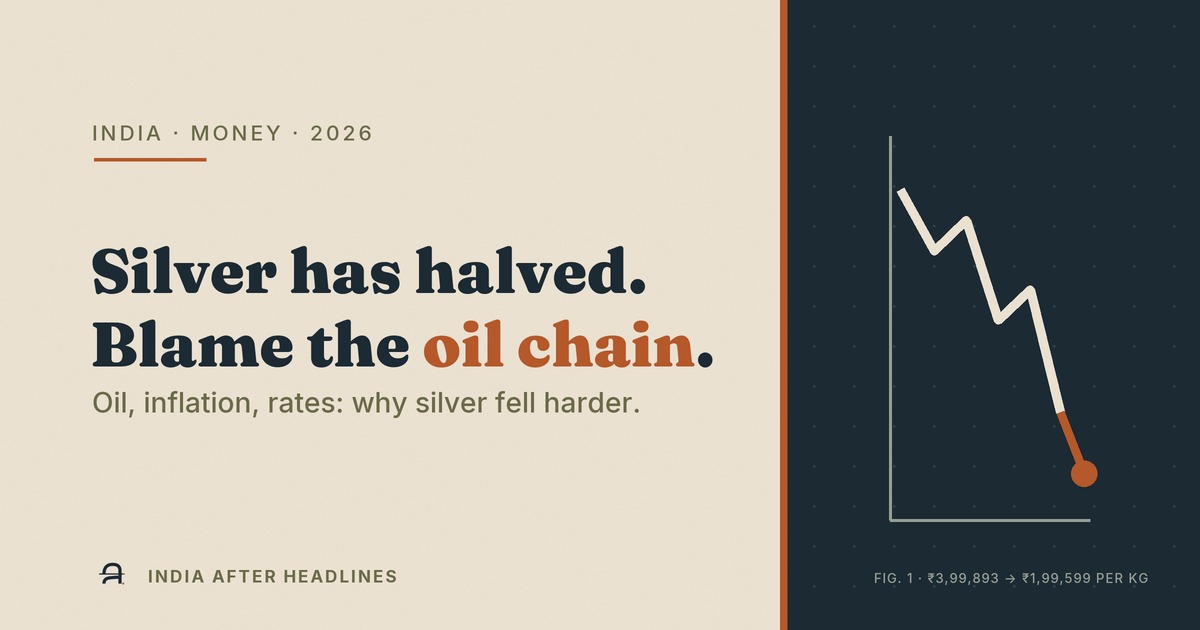
Why Has Silver Halved in 2026? From ₹4 Lakh to ₹2 Lakh a Kilo, Explained
Silver closed at half its January record on 22 October. It wasn't a scam or a collapse in demand for jewellery. It was a chain that started with crude oil.
PSU Bank Stake Sale 2026: Central Bank, UCO, IOB, Punjab & Sind — Is Your FD Safe?
After IDBI, the government wants to sell part of four more banks. That part isn't privatisation, and the legal cover on your deposit never depended on who owns the bank.