
Indian IT Revenue Is Rising and Hiring Isn't Coming Back. Here's Why
TCS grew revenue 13.9% and ended the year with 19,271 fewer people. Nobody was fired for it. The rope tying revenue to jobs has snapped.
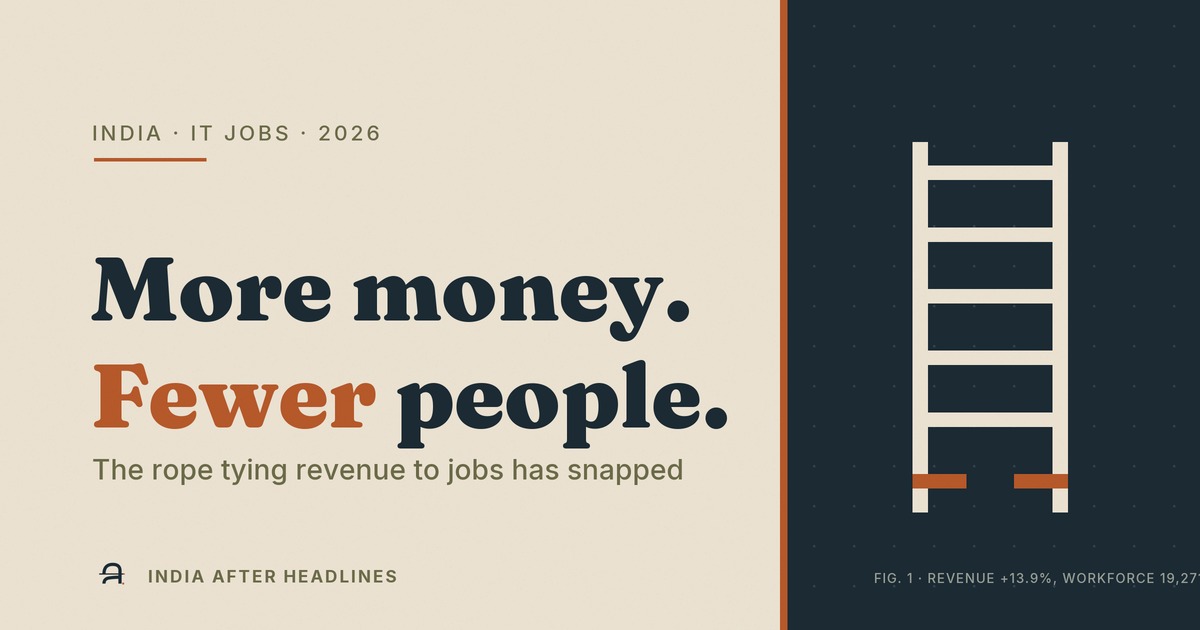
Short answer: Indian IT’s revenue and its headcount have come apart. TCS reported Rs 72,275 crore in Q1 FY27 (April-June 2026), up 13.9% year on year — and over the same twelve months its workforce went from 613,069 to 593,798: 19,271 fewer people. That did not happen through mass firing. TCS says the layoff phase is over, and it added 9,279 people that same quarter. The mechanism is non-replacement. The cause is not AI, it is the business model: for thirty years Indian IT sold effort per person per hour, and clients now buy outcomes. Which makes the standard advice — “the market is bad, just wait it out” — actively wrong. The old model didn’t break. It got replaced, and the replacement runs on fewer people.
Two numbers on one press release
They were never printed side by side, and side by side is the only way they mean anything.
| TCS, twelve months to 30 June 2026 | |
|---|---|
| Revenue (Q1 FY27) | Rs 72,275 crore, +13.9% YoY |
| Order book | USD 9.5 billion |
| Workforce, 30 June 2025 | 613,069 |
| Workforce, 30 June 2026 | 593,798 |
| Net change | -19,271 people |
More money. Fewer people. Same company, same document.
First, let’s kill the version going around
The internet’s account of this quarter is that the big four bled people. That is simply false, and repeating it makes the real problem harder to see.
| Company | Q1 FY27 net headcount change |
|---|---|
| TCS | +9,279 |
| Wipro | +888 |
| Infosys | -532 |
| HCLTech | -3,292 |
| Combined | +6,343 |
Across a workforce of 13,88,793. That is not hiring — 6,343 on that base is a rounding error. But it is not a bloodbath either.
So if nobody was fired at scale and the headcount didn’t collapse, why does it feel like the door shut?
Because of the seat that emptied and was never filled again. That is what non-replacement looks like from inside an office, and it never generates a headline.
The pyramid was the product
Here is the part that explains everything else.
Indian IT services was built as a pyramid: a wide, inexpensive base of junior engineers under a thin senior layer. That shape was not an accident of hiring — it was the product, because clients bought effort measured per person per hour. More work meant more people, so revenue growth and headcount growth were the same movement.
Then the client changed the question. Not “how many people will you put on this” but “by when, and for how much”.
The moment the unit of sale stops being a person-hour, the pyramid stops being an asset and starts being a cost. The rope between revenue and jobs snaps — and a snapped rope does not recover. It has to be tied again, from the other end.
But isn’t this just the usual downturn?
The strongest version of the counter-argument deserves stating properly, because half of it is right.
The 2022-23 bench bubble really is deflating. Hiring really did freeze after the dot-com crash and again in 2008-09, and it really did come back bigger both times. Attrition is around 13%. Projections still put growth at 12-15%.
Three things that argument cannot absorb:
1. Last time the pyramid was rebuilt. This time it is being replaced. AI is absorbing precisely the routine coding, testing, maintenance and documentation work that the wide base existed to sell.
2. Hiring didn’t fall so much as move. Naukri JobSpeak’s June 2026 data: overall IT hiring -3% YoY, AI hiring within IT +16%, AI/ML hiring +25% across 14 industries, led by insurance and consumer goods. Info Edge’s Hitesh Oberoi has flagged the shift toward senior and specialised talent. A business cycle reduces demand. A business cycle does not relocate demand into insurance.
3. A revenue line exists now that didn’t in 2008. Infosys reported AI-related revenue at 8.2% of total in Q1 FY27 — revenue that does not scale with headcount.
And the demand story kills the recession framing outright: TCS’s USD 9.5 billion order book and HCLTech’s highest-ever Q1 net-new booking at USD 2,407 million — booked with 3,292 fewer people.
So is AI eating IT jobs?
No, and the lazy version of that claim is doing real damage to people making career decisions.
Record bookings. TCS onboarding roughly 14,000 campus graduates in the quarter. AI roles up 16-25%. This is a re-sort, not an annihilation.
What has genuinely changed is the entry door. TCS hired 44,000 freshers in FY26; in FY27 it had made 25,000 offers as of April 2026, with the CEO saying the number may rise on better demand visibility and the HR head pointing at roughly 40,000. TCS’s own stated reason is a changing delivery model, not AI.
The company has not announced a cut to its target. What it has done is stop announcing the number a year in advance. The campus door’s width is now set quarterly. It used to be a number; it is now a “depends”.
What to actually do
The advice to wait is the one thing that is now measurably wrong. Waiting used to be caution. It is now a price, paid in months.
1. Stop searching “IT job”. Search AI and ML roles outside IT services — insurance and consumer goods are where the growth actually showed up.
2. Target a GCC rather than a services firm. Different economics, different reason for your seat to exist.
3. If you are in a Tier-2 or Tier-3 city, the free capacity is real and mostly empty. IndiaAI Mission has approved 58 AI Centres of Excellence, 543 Data & AI Labs in ITIs and polytechnics, and 686 fellowships across 178 institutions. The deliberately non-metro design here deserves credit. The scale does not: NASSCOM expects AI job demand to cross 1 million by 2026 against roughly 16% of Indian IT professionals being AI-skilled. The design is right and it is short by a full zero.
4. Leave the automatable middle on purpose. L1 support, manual QA, legacy application maintenance, routine testing and documentation. If that is your day, that is your notice period. Internal transfer is the cheapest move you will ever make.
Note what is missing from that list: “upskill”. It is an empty word that tells you to do something without telling you what, where, or how you would know it worked.
The part for parents paying fees
Placement used to arrive with the degree. It now arrives with whatever you added on top of it. That is a harder deal, and pretending otherwise helps nobody.
What broke is not the market. It is the rope that tied revenue to jobs — and a broken rope doesn’t recover. It gets tied again, from the other end.
Sources
- Tata Consultancy Services Q1 FY27 (April-June 2026) results — revenue Rs 72,275 crore, up 13.9% year on year; order book of USD 9.5 billion; workforce 593,798 as on 30 June 2026 against 613,069 as on 30 June 2025, a reduction of 19,271 over twelve months; net addition of 9,279 employees during the quarter; approximately 14,000 campus graduates onboarded in the quarter
- Q1 FY27 net headcount change across the four largest Indian IT services firms — TCS +9,279, Wipro +888, Infosys -532, HCLTech -3,292, a combined net addition of 6,343 across a workforce of 13,88,793
- HCLTech Q1 FY27 — highest-ever first-quarter net new booking of USD 2,407 million, recorded in the same quarter the company reduced headcount by 3,292
- TCS fresher hiring — 44,000 freshers hired in FY26; 25,000 offers made in FY27 as of April 2026; CEO K Krithivasan stated the number may rise if demand visibility improves and the HR head indicated the company is on track for approximately 40,000; TCS attributes the change to a changing delivery model rather than to AI
- Naukri JobSpeak, June 2026 data released 3 July 2026 — overall IT hiring down 3% year on year, AI hiring within IT up 16% year on year, AI/ML hiring up 25% across 14 industries, led by insurance and consumer goods; Info Edge CEO Hitesh Oberoi noted demand shifting toward more senior and specialised talent
- Infosys Q1 FY27 — AI-related revenue reported at 8.2% of total revenue
- IndiaAI Mission — 58 AI Centres of Excellence approved, 543 Data & AI Labs in Tier-2 and Tier-3 ITIs and polytechnics, and 686 fellowships across 178 institutions
- NASSCOM — AI-related job demand expected to cross 1 million by 2026, against approximately 16% of Indian IT professionals currently AI-skilled
Why is IT hiring not recovering in India in 2026?
Because the thing people are waiting to recover has been replaced rather than damaged. For thirty years Indian IT services sold effort measured per person per hour, so revenue growth required headcount growth. Clients now buy outcomes instead. Revenue and headcount have therefore come apart: TCS grew revenue 13.9% year on year in Q1 FY27 while ending the same twelve months with 19,271 fewer people. Volumes may return; the ratio of people to revenue will not.
Did Indian IT companies cut jobs in Q1 FY27?
Combined headcount actually rose. Net change across the four largest firms was TCS +9,279, Wipro +888, Infosys -532 and HCLTech -3,292, a combined addition of 6,343 across a workforce of 13,88,793. That is a rounding error on that base, not hiring — and it is not a mass layoff either. The mechanism is non-replacement: seats that empty are not backfilled.
Is AI taking IT jobs in India?
Not in the way the phrase suggests. Demand is at record highs, with TCS reporting a USD 9.5 billion order book and HCLTech its highest-ever Q1 net new booking of USD 2,407 million. AI roles are growing: AI hiring within IT is up 16% year on year and AI/ML hiring is up 25% across 14 industries. What AI is absorbing is the routine coding, testing, maintenance and documentation work that the wide junior base existed to sell. The story is re-sorting, not annihilation.
How many freshers is TCS hiring in FY27?
TCS hired 44,000 freshers in FY26 and had made 25,000 offers in FY27 as of April 2026. The company has not announced a reduced target: CEO K Krithivasan said the number may rise if demand visibility improves, and the HR head indicated the company is on track for approximately 40,000. TCS attributes the change to a changing delivery model, not to AI. It onboarded roughly 14,000 campus graduates in Q1 FY27.
Where did the IT jobs go?
They moved rather than vanished. Naukri JobSpeak data for June 2026 shows overall IT hiring down 3% year on year while AI hiring within IT rose 16% and AI/ML hiring rose 25% across 14 industries, led by insurance and consumer goods. Demand also shifted toward more senior and specialised roles. The search term 'IT job' now misses a large share of where the hiring actually is.
Will AI Take Your IT Job in India? The Honest 2026 Answer: It's the Rung, Not the Job
AI didn't break the building. It removed the bottom step — the routine work every fresher used to learn on. That's a harder problem, and a clearer fix.
Are Indian IT Companies Still Hiring Freshers in 2026 — While Firing Thousands?
Both headlines are true at the same time. That isn't a contradiction. It's the plan.