
EPF Wage Ceiling Rs 15,000 to Rs 25,000: What Has Been Decided, and What Has Not
The ceiling is still Rs 15,000, set in 2014. But the statute underneath it quietly changed on 29 June 2026 — and almost nobody covered that part.
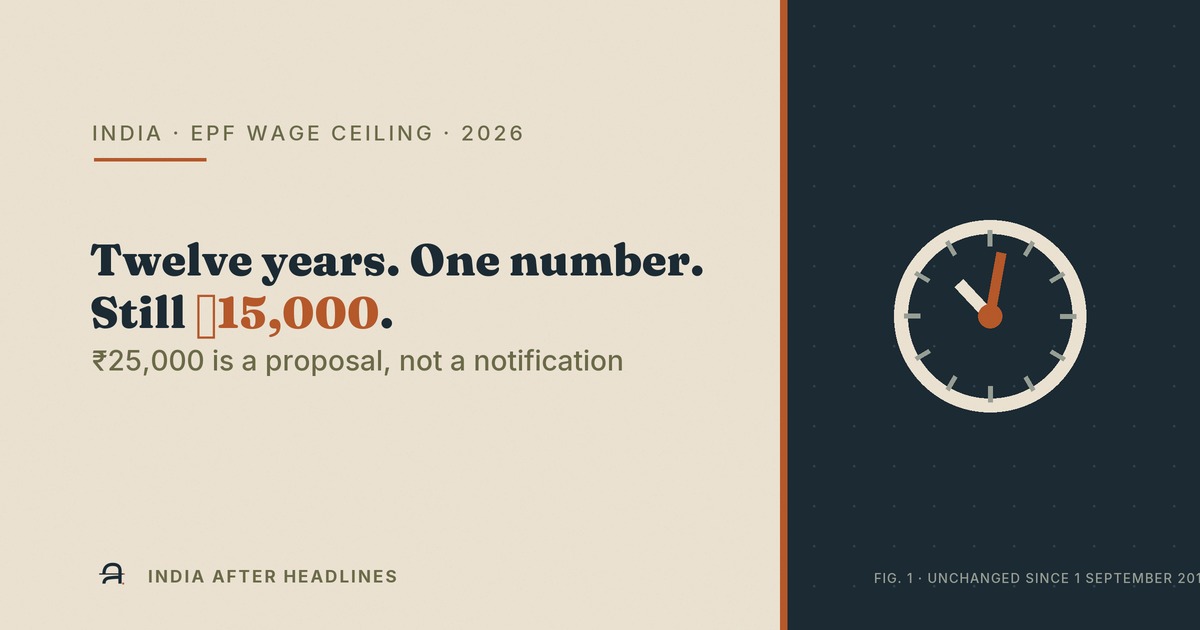
Short answer: No — the EPF wage ceiling has not been raised. As of 10 August 2026 it remains Rs 15,000 per month, the level set with effect from 1 September 2014. Rs 25,000 is a proposal: there is no gazette notification, no Union Cabinet approval and no official statement from EPFO or the Ministry of Labour & Employment putting it into force. Meanwhile, the thing that did change went largely unreported — since 29 June 2026 the operative instruments are the Employees’ Pension Scheme 2026, EPF Scheme 2026 and EDLI 2026, notified under the Code on Social Security, 2020, not EPS-95 or the EPF Act, 1952.
The number that hasn’t moved in twelve years
Rs 15,000. Set in an August 2014 notification, effective 1 September 2014, replacing the earlier Rs 6,500.
Twelve years of inflation later, it is still Rs 15,000. That is the entire grievance, and it is a fair one.
What it is not is a change. If you have read that the limit “has been hiked”, you have read a headline that ran ahead of the gazette.
The timeline, including the part that contradicts itself
| Date | What happened | Status |
|---|---|---|
| 1 September 2014 | Ceiling set at Rs 15,000 | In force |
| 6 January 2026 | Supreme Court directs Centre and EPFO to decide within four months | Judicial direction — the only Tier-1 dated instrument here |
| 14 July 2026 | Reported on hold, pending stakeholder consultation | Unnamed sources |
| 3 August 2026 | Reported cleared by the Finance Ministry | Unnamed sources |
| Today | No Cabinet approval, no gazette | Still Rs 15,000 |
Note rows four and five. They contradict each other, they are both anonymously sourced, and we are not going to smooth that over for you. On hold in July, cleared in August, official nowhere. Only a gazette notification settles it.
The Supreme Court’s role is worth stating precisely, since it is the one hard fact in the sequence: on 6 January 2026, Justices J.K. Maheshwari and Atul S. Chandurkar, hearing an Article 32 petition by advocates Pranav Sachdeva and Neha Rathi that called the Rs 15,000 threshold “arbitrary and irrational”, directed the Centre and EPFO to decide within four months. A direction to decide is not a direction to raise.
The part almost nobody covered: 29 June 2026
While the country argued about a number that hasn’t changed, the statute beneath it was replaced.
| Until 28 June 2026 | From 29 June 2026 |
|---|---|
| EPF Scheme, 1952 | EPF Scheme, 2026 |
| Employees’ Pension Scheme, 1995 | Employees’ Pension Scheme, 2026 |
| Employees’ Family Pension Scheme, 1971 | Superseded by EPS 2026 |
| EDLI Scheme, 1976 | EDLI Scheme, 2026 |
| Framed under the EPF & Misc. Provisions Act, 1952 | Notified under section 15(1)(b), Code on Social Security, 2020 |
Accrued rights and running pensions are preserved. What changed is the legal basis, not what you have already earned. And the four labour codes themselves came into force on 21 November 2025, rationalising 29 central laws.
If you are studying this topic, that paragraph is worth more than the entire Rs 25,000 news cycle. It is the part that stays true next year.
Contribution structure
| Component | Rate |
|---|---|
| Employee | 12% — entirely to EPF |
| Employer | 12% — split 8.33% to EPS, 3.67% to EPF |
| Employer, additionally | 0.50% EDLI + 0.50% administrative charges |
| Central Government | 1.16% to EPS, up to the Rs 15,000 ceiling |
| Employer’s EPS share | capped at Rs 1,250/month |
Rates under the 2026 schemes are subject to government notification.
The hinge nobody explains
Under EPF Scheme 2026, the mandatory 12% applies only up to the ceiling — a cap of Rs 1,800 per month. Above the ceiling, the employee’s contribution is voluntary, and the employer is not obliged to match it.
Read that again, because it reframes the whole debate. The ceiling does not merely decide how much salary gets diverted into EPS. It decides where the employer’s legal liability stops. That is why this is a slow file, and it is why the argument is really between payroll costs and pension adequacy rather than between two numbers.
The pension formula, and the arithmetic
Monthly pension = (pensionable salary x pensionable service) / 70
Pensionable salary is the average monthly wages of the last 60 months, capped at the notified ceiling. Minimum pensionable service: 10 years.
Working it at the current ceiling versus the proposed one — and this is a derivation from statutory rates, not a government figure:
| Pensionable service | At Rs 15,000 ceiling | At a Rs 25,000 ceiling |
|---|---|---|
| 10 years | Rs 2,143/month | Rs 3,571/month |
| 20 years | Rs 4,286/month | Rs 7,143/month |
| 35 years | Rs 7,500/month | Rs 12,500/month |
Against which sits the statutory minimum pension of Rs 1,000 a month — also unchanged since 1 September 2014.
On contributions, again as a derivation: at a Rs 25,000 ceiling the 12% mandatory contribution rises from Rs 1,800 to Rs 3,000 on each side. That is roughly Rs 1,200 a month less in hand for the employee — about Rs 14,400 a year — and roughly Rs 15,600 a year more in cost per employee for the employer. Deferred pay, not lost pay. But it lands in the take-home column, which is where people actually feel it.
Who would be affected
Anyone whose EPF wages sit above Rs 15,000 but at or below Rs 25,000, whose employer currently contributes only to the capped amount. Not gig workers — this threshold does not cover them, whatever the headlines say.
What to actually do
Nothing yet, and that is the honest answer. There is no election of options to make, no form to file and no deadline running.
What is worth doing is knowing which document ends the argument: a gazette notification from the Ministry of Labour & Employment. Not a news report, not an unnamed official, not a date in a WhatsApp forward. When that lands, this page gets updated.
The villain here isn’t a government or a ministry. It’s a threshold that stopped being updated, in a system where the number and the liability are the same number.
Sources
- Ministry of Labour & Employment notification of August 2014, effective 1 September 2014 — raised the EPF wage ceiling from Rs 6,500 to Rs 15,000 per month; the minimum EPS pension of Rs 1,000 per month dates from the same date. The ceiling has not been revised since
- Supreme Court of India, 6 January 2026 — Justices J.K. Maheshwari and Atul S. Chandurkar, on an Article 32 petition by advocates Pranav Sachdeva and Neha Rathi describing the Rs 15,000 ceiling as arbitrary and irrational, directed the Centre and EPFO to take a decision within four months
- Press reports, 14 July 2026 — the proposal reported to be on hold pending stakeholder consultation; press reports, 3 August 2026 — the proposal reported cleared by the Finance Ministry. Both rest on unnamed sources; neither is an official statement, and no Union Cabinet approval or gazette notification has issued
- Ministry of Labour & Employment — Employees' Pension Scheme 2026 notified 29 June 2026 under section 15(1)(b) of the Code on Social Security, 2020, superseding the Employees' Pension Scheme 1995 and the Employees' Family Pension Scheme 1971; EPF Scheme 2026 superseding EPF Scheme 1952; EDLI Scheme 2026 superseding EDLI 1976. Accrued rights and running pensions preserved
- The four labour codes came into force on 21 November 2025, rationalising 29 central labour laws
- Employees' Pension Scheme — monthly pension formula: (pensionable salary x pensionable service) / 70, where pensionable salary is the average monthly wages of the last 60 months capped at the notified ceiling; minimum pensionable service 10 years; minimum pension Rs 1,000 per month since 1 September 2014
- Contribution structure — employee 12% (entirely to EPF); employer 12%, split 8.33% to EPS and 3.67% to EPF; employer additionally pays 0.50% EDLI and 0.50% administrative charges; the Central Government contributes 1.16% to EPS up to the Rs 15,000 ceiling; the employer's EPS share is capped at Rs 1,250 per month. Rates under the 2026 schemes are subject to government notification
- EPF Scheme 2026 — the mandatory 12% applies only up to the wage ceiling, a cap of Rs 1,800 per month; above the ceiling the employee's contribution is voluntary and the employer is not obliged to match
Has the EPF wage ceiling been raised to Rs 25,000?
No. As of 10 August 2026 the statutory EPF wage ceiling remains Rs 15,000 per month, the level set with effect from 1 September 2014. Raising it to Rs 25,000 is a proposal reported in the press. There is no gazette notification, no Union Cabinet approval, and no official statement from EPFO or the Ministry of Labour & Employment putting Rs 25,000 into force.
PF limit 15000 se 25000 kab badhega?
Abhi tak nahi — no date has been fixed. The Supreme Court directed the Centre and EPFO on 6 January 2026 to decide within four months, and press reports since have contradicted each other: on hold in July, cleared by the Finance Ministry in August. Dates circulating for implementation are journalistic expectation, not notified law. Only a gazette notification settles it.
What is the difference between EPS 2026 and EPS 95?
EPS 1995 was framed under the EPF & Miscellaneous Provisions Act, 1952. The Employees' Pension Scheme 2026, notified on 29 June 2026 under section 15(1)(b) of the Code on Social Security, 2020, supersedes both EPS 1995 and the Employees' Family Pension Scheme 1971. EPF Scheme 2026 replaced EPF Scheme 1952 and EDLI 2026 replaced EDLI 1976 on the same date. Accrued rights and running pensions are preserved — the legal basis changed, not the entitlements already earned.
How is the EPS pension calculated?
Monthly pension = (pensionable salary x pensionable service) / 70. Pensionable salary is the average monthly wages of the last 60 months, capped at the notified wage ceiling. Minimum pensionable service is 10 years and the minimum pension is Rs 1,000 per month, unchanged since 1 September 2014. At the current Rs 15,000 ceiling and 35 years of service the formula gives Rs 7,500 a month; at a Rs 25,000 ceiling the same service would give Rs 12,500.
Which labour codes are relevant for current affairs and exams?
The four labour codes came into force on 21 November 2025, rationalising 29 central labour laws. The Code on Social Security, 2020 is the operative one here: the EPS 2026, EPF Scheme 2026 and EDLI 2026 were notified under it on 29 June 2026, replacing the schemes framed under the EPF & Miscellaneous Provisions Act, 1952.

Fake E-Challan SMS: How Scammers Know Your Vehicle Number, and How to Check in 30 Seconds
The fine is invented. The vehicle number in it is not. Here's where that number comes from, and the one check that settles it.

Are Cancer Medicines Getting Cheaper in India? Yes, From 9 November — If You Check
The government has capped what middlemen can add to 137 cancer drugs. Prices should fall 20 to 70% from 9 November. Almost nobody paying for chemotherapy has heard about it.

The WhatsApp 'Reply NO' Scam: No OTP, No Link — Here's What Actually Takes the Money
Hyderabad Police warn of WhatsApp messages that say money has left your account and ask you to reply NO. There's no OTP and no link. The panic does the work. Here's the one rule that beats it, the settings that help, and the 3-day RBI window if money does go.